Posts

Blind, But Now I See

3-26-17 (Lent 4A) 1 Samuel 16:1-13; John 9:1-41 Blind, But Now I See One of the most painful experiences I have ever had was the day we learned that a part of Caleb’s brain hadn’t developed the way it was supposed to.  Officially, it’s called Dandy-Walker Malformation - that was the name that the doctor told us in the ultrasound room before offering his condolences and ushering us into another room to meet with a genetics counselor.  At the time, however, it was a mixture of having the rug pulled out from under us and having a bucket of ice-water dumped over our heads.  We didn’t know really anything about what it would mean for us or for our son, but what we did know was that suddenly everything in our world had changed - every image we’d painted for ourselves of our child was suddenly shattered and was going to be replaced with something different. As we drove home that day, the question on our minds was an awful lot like the question on the lips of t...

Siren Songs and Samaritan Struggles

3-19-17 (Lent 3A) Romans 5:1-11; John 4:5-42 Siren Songs and Samaritan Struggles In Homer’s epic greek poem The Odyssey, the hero Odysseus and his men are trying to return home.  A part of their journey takes them past the land of some dangerous creatures called sirens.  The sirens were dangerous because they sang a song that was so alluring, so compelling, that it caused any sailors who passed by them and heard it to go dashing to their deaths on the rocks as they irresistibly tried to follow the sound of the singing.  Odysseus wanted to know what their song sounded like, but at the same time, he didn’t want to risk death, either for himself or for his crew.  So he came up with a pretty clever, though still dangerous, solution: he ordered his crew to tie him to the mast of their ship so that he could hear the sirens singing but not do anything about it, and then the crew were given explicit orders to plug their ears with beeswax and then to focus on thei...

Church 3:16

Image
3-12-17 (Lent 2A) Romans 4:1-5, 13-17; John 3:1-17 Church 3:16 If I were to stop you suddenly and randomly in the produce section at County Market, and ask you off the top of your head to quote a Bible verse off the top of your head, without any preparation, any time to genuinely think… what would that verse be?  Nine times out of ten, I’d bet any amount of money that your go-to answer would be John 3:16. For God so loved the world… By far, this is one of the most memorized scripture verses in the Christian tradition - it speaks in just about every denomination, every tradition, every experience.  And while it’s one of many such verses that fit this description, it’s commonly referred to as the “Gospel in a nutshell.”  It contains the basic message of God’s love, the significance of Jesus’ sacrifice, and our own call to faithful response in the light Christ’s salvation for us. While it’s likely the first verse that a lot of us may have memoriz...

The Devil Went Down to Jordan

3-5-17 (Lent 1A) Genesis 2:15-17, 3:1-7; Matthew 4:1-11 The Devil Went Down to Jordan Do you ever stop and wonder just how much of your theology and biblical understanding is shaped by Charlie Daniels?  It sounds like a weird question, I know… but take a second and think about it again. When you hear the familiar story told that serves as the entire foundation for this season of Lent, what do you envision?  Do you hear the jangle of guitar strings as the opening chords play and old Charlie starts singing “The Devil went down to Jordan, he was looking for a soul to steal?”  OK so maybe not quite that on the money… but when you think about the ways this has been dramatized over the years, the art that has come out, the ways we have let this scen play out in our imaginations over the generations, it’s easy to see this scene as an epic showdown between good and evil, Satan doing everything in his power to trip up Jesus, Jesus staying stoic and stalwart, refus...

What Happens On the Mountain

2-26-17 (Transfiguration A) 2 Peter 1:16-21; Matthew 17:1-9 What Happens on the Mountain What would you have done if you were in the shoes of Peter, James, or John?  What would you have done if you had been there, on the top of that mountain, and you had seen the things that they’d seen - Moses and Elijah standing beside the man you’d been following, whose  clothes are now glowing the brightest white you’ve ever seen and whose face is blindingly bright, glowing like the morning sun ?  What would you have done? Would you be dumbstruck, as James and John appear to have been in the moment?  Would you gaze in awe and wonder for as long as you could at that bright and shining face until you couldn’t bear to look anymore, and even then still have the afterimage burned into your retinas?  Would you see Moses and Elijah standing beside Jesus and have the sudden, dawning awareness rush over you that this is, in fact, real ?  Would you finally, once...

Turning Cheeks and Punching Nazis

Image
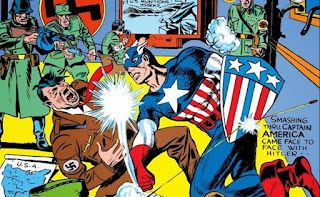
2-19-17 (Epiphany 7A) Leviticus 19:1-2. 9-18; Matthew 5:38-48 Turning Cheeks and Punching Nazis If you thought my sermon was on the weird side last week, I’m going to apologize in advance for what you’re about to hear this week.  It starts with just one question:  Is it OK to punch a Nazi?  It’s the kind of question that seems straightforward, but when we really start digging down into how we feel, how we want to answer, and how we think we’re supposed to answer… well, perhaps it’s not such an easy question after all.     Strangely enough, it’s a question that has actually warranted genuine discussion within the last month.  It came up after Richard Spencer, a prominent white nationalist, was punched in the face by an anonymous protester while giving an on-camera interview on the day of the Presidential Inauguration.  It’s the kind of news you can’t make up - and while these kind of headlines are seeming to be more and more ...

It is Known

Image
2-12-17 (Epiphany 6A) Deuteronomy 30:15-20; Matthew 5:21-37 It is Known There’s a saying that gets thrown around in both the book series and the television adaptation of George R. R. Martin’s Game of Thrones that immediately came to mind for me this week as I read through this next portion of Jesus’ sermon on the mount.  It comes from the nomadic warrior people, called the Dothraki, and it’s a phrase that is used over and over again to indicate that a piece of information is common knowledge, accepted as absolute fact, unchallenged for centuries kind of wisdom: they say “It is known.”  And then usually someone repeats the phrase for emphasis and agreement.  “It is known.”  In the Game of Thrones universe, the things that are known are numerous, though they are not always known in the same way by one of the main characters, who finds herself thrust into an alien culture and has to learn everything by trial and error.  “It is known” that dragons have...